Forty Years in the Same Direction: The Artists Who Don't Need You to Notice Yet
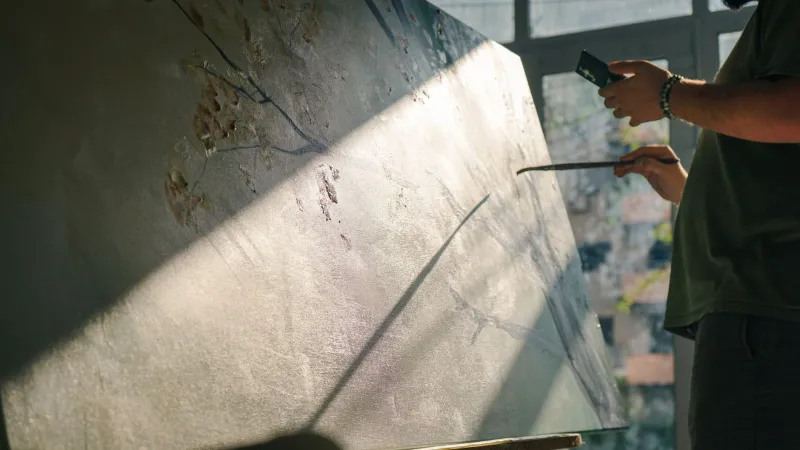
There is a painter in rural Vermont who has been making the same series of paintings for thirty-one years. Not variations on a theme. Not a body of work loosely connected by sensibility. The same series — same subject, same palette range, same approximate scale — continuously developed since 1993. He has had two solo shows in that time. He is not represented by a gallery. He is not on social media. He teaches a few private students to pay his bills and spends the rest of his time in the studio.
He is also, by almost any serious measure, one of the most accomplished painters working in the United States today. The people who know his work tend to speak about it the way people speak about a landscape they've lived inside for years — not impressed by it, exactly, but shaped by it.
He's not a recluse. He's not bitter. He's not waiting. He's just working on a timeline that has nothing to do with the one the art world operates on.
The Other Clock
The contemporary art ecosystem runs fast. Grant cycles are annual. Exhibition schedules are planned two years out and reviewed two weeks after they open. Social media compresses attention into days, sometimes hours. The expectation — implicit but pervasive — is that a serious artist should be producing, showing, applying, networking, and building a public presence on a more or less continuous basis.
This is one way to run a practice. It is not the only way, and a growing number of artists would argue it's not even a particularly good way, if what you're trying to do is make work that accumulates genuine depth over time.
The artists who operate on long timelines — twenty, thirty, forty years of sustained focus on a single set of questions — are not making a virtue of obscurity. They're making a structural argument: that certain kinds of creative development are simply incompatible with the pace and visibility demands of the mainstream art world, and that choosing depth over exposure is not a consolation prize but a deliberate strategy.
What Patience Actually Builds
A sculptor based in New Mexico has been working with the same geological formation — a stretch of arroyos and mesas about forty miles from her studio — for twenty-six years. Her work involves site-specific interventions, documentation, and an ongoing written record that now runs to several hundred thousand words. She has applied for exactly two grants in that time, received one, and used the money to buy better cameras.
"People ask me what the project is about," she says. "I don't really know yet. I've been working on it for twenty-six years and I'm still in the early stages of understanding what I'm looking at."
That statement would sound like false modesty from someone who hadn't actually spent twenty-six years looking. From her, it sounds like precision. Long-form creative practice develops a particular kind of perceptual acuity — the ability to notice change across decades, to hold contradictions in suspension without resolving them prematurely, to let understanding arrive on its own schedule rather than forcing it to fit a deadline.
This is not something you can fake or accelerate. It requires time, and it requires the willingness to spend that time in relative obscurity, because the work isn't ready to be shown and you know it.
Obscurity as Condition, Not Consequence
The conventional story about artistic obscurity is that it's something to be overcome — a temporary state between where you are and where you're trying to get to. The artists on long timelines tend to tell a different story. For them, obscurity isn't a problem to be solved. It's a condition that makes certain kinds of work possible.
When you're not visible, you're not accountable to an audience's expectations. You're not managing a reputation. You're not making decisions based on what sold last time or what got the best response at the last opening. You're just making work, and the work can go wherever it needs to go without asking permission.
A Chicago-based sound artist who has been developing a single long-form audio piece since 2001 — he estimates it will be finished sometime in the next decade — describes his obscurity as "load-bearing." It holds the project up. If he were visible, if people were waiting for this, if there were institutional expectations attached to it, he doesn't think the piece would survive.
"The work needs to be able to fail for years at a time," he says. "It needs to be able to go nowhere. You can't do that if people are watching."
The Accumulation
What these practitioners share is a belief in accumulation — not the accumulation of a resume or a career, but the accumulation of understanding. Each year of sustained focus on the same set of questions builds on the previous years in ways that can't be replicated by moving between projects or chasing new directions.
The Vermont painter talks about this in terms of seeing. After thirty-one years with the same subject, he sees things in it that he couldn't have seen in year five or year fifteen. Not because he's smarter, but because he's looked longer. The subject has revealed itself slowly, and the revelation is ongoing.
This is, in a sense, the opposite of the mastery narrative that dominates most discussions of artistic development — the idea that you get better and better until you've conquered your material. What these artists describe is more like a deepening relationship, one that gets more complex and more rewarding the longer it continues, without ever arriving at resolution.
"I'm not trying to finish," the sculptor says. "I'm trying to understand. Those aren't the same project."
The art world will catch up with some of these practitioners eventually, or it won't. Either way, the work continues. The clock runs differently out here, and the people working by it seem, on balance, pretty okay with that.