Pay What the Work Is Worth: Inside the Underground Economies Keeping Artists Alive

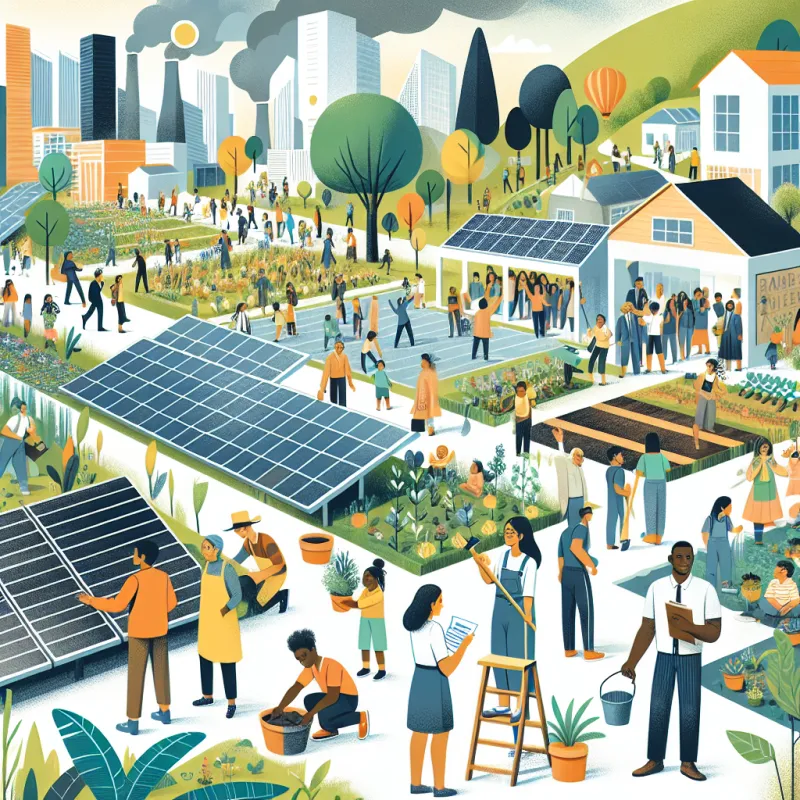
Photo: community artists bartering skills exchange informal economy workshop, via videobeladiri.com
There's a question that floats around every artist residency, every activist planning meeting, every late-night studio session: how do you actually survive doing this? The honest answer, for most people, has been: you don't. You pick up a service job, you hustle freelance gigs, you apply for the same three grants everyone else is applying for, and you carve out whatever time is left for the work that actually matters to you.
But something is shifting. Quietly, experimentally — and in very O Project fashion — a loose network of practitioners across the US is building something different. Not a silver bullet. Not a platform with a waiting list. Just a messy, living set of alternatives that are letting artists and organizers get paid for the work that matters, on terms they actually helped design.
The Barter Isn't What You Think It Is
When people hear "barter economy," they picture farmers trading eggs for firewood. What's actually happening inside creative communities looks a lot more sophisticated — and a lot more intentional.
In Detroit, a loose collective called the Mutual Craft Register has been operating for about four years now. It functions like a skills ledger: members log what they can offer (graphic design, electrical work, childcare, translation, legal research) and what they need, and the exchange happens in time credits rather than cash. A muralist who needs their taxes done earns credits by running a community printmaking workshop. An organizer who needs a website built offers six hours of strategic facilitation in return.
What makes it different from the barter setups that fizzled out in the '90s is the community governance layer. The Register has a rotating stewardship council that actively manages equity — making sure the system doesn't just replicate existing hierarchies where people with high-demand technical skills accumulate credits while caregivers and community educators stay in the red. "We had to build the anti-exploitation clause in from the start," says one of the founding members, who asked to be identified only as Dara. "Otherwise you just get capitalism with extra steps."
Pooling the Risk
In Chicago, a group of about thirty artists has been running what they call a "floor fund" for the past two years. Each member contributes what they can monthly — anywhere from fifteen to two hundred dollars — into a shared pool. When someone in the group hits a financial wall (a medical bill, a gap between projects, a sudden housing crisis), they can draw from the fund without interest and without the performance of financial distress that comes with applying for emergency grants.
The floor fund doesn't replace income. But it flattens the most destabilizing spikes. "The thing that kills creative work isn't poverty, exactly," says Ximena, a textile artist and one of the fund's organizers. "It's unpredictability. You can work with less if you know what you're working with. The fund gave us that."
They've also started using a portion of the pool to commission work directly from members — paying someone to design a zine, paying someone else to document a performance, paying a poet to write something for their shared newsletter. The line between mutual aid and patronage blurs in interesting ways. "We're funding each other," Ximena says. "That's just true."
Community-Supported Art (Yes, Like a CSA)
The community-supported agriculture model — where subscribers pay upfront for a season's worth of produce — has been adapted and re-adapted by artists for years, but a newer generation of practitioners is pushing it further than the typical "buy a print, get a postcard" version.
In New Orleans, a photographer named Kwame runs what he calls a Community-Supported Documentary practice. Forty-something subscribers pay between ten and sixty dollars a month. In return, they get access to his ongoing long-form work — not finished products, but the actual process: rough cuts, field notes, the images that didn't make the edit and why. Twice a year, subscribers collectively vote on which of three proposed projects he pursues next.
"It changes the relationship completely," Kwame says. "I'm not making work for a funder's priorities or a gallery's aesthetic. I'm accountable to the people who live in the same city I'm documenting. That's a different kind of accountability, and honestly, a better one."
The model isn't without friction. Collective decision-making takes time. Some subscribers want more finished product than process. But Kwame says the creative freedom it buys him is worth the negotiation. He hasn't applied for a grant in eighteen months.
What These Models Are Actually Doing
It would be easy to romanticize all of this — to treat alternative economic structures as inherently radical just because they exist outside the mainstream. But the practitioners building these systems are pretty clear-eyed about the limits.
None of these models scale easily. The Mutual Craft Register works because its members know each other and trust the governance structure — that trust took years to build and can't be replicated by downloading an app. The floor fund in Chicago has already had one messy renegotiation when a member drew from it in a way others felt violated the spirit of the agreement. Community-supported models require a level of audience engagement that many artists find exhausting.
And none of them fully solve the material reality that making art and doing organizing work in the US is structurally undersupported. These are patches, not infrastructure.
But patches matter. "Every system that doesn't require me to perform my need for a gatekeeper is a system that gives me more time to actually work," says Dara from the Detroit collective. "That's not nothing. That's actually a lot."
The Deeper Experiment
What's most interesting about these underground economies isn't the mechanics — it's what they're quietly arguing about value. The traditional art market says a work is worth what a collector will pay. The grant system says work is worth what it can be made to do for institutional priorities. These alternative structures are proposing something different: that the work has value because the community it serves says so, and that the person making it deserves to be sustained in the process.
That's not just an economic argument. It's an aesthetic one. It shapes what gets made, who feels permitted to make it, and what risks feel possible to take.
The care economy, in other words, isn't just about getting paid. It's about building conditions where the work that matters can actually happen — messy, underfunded, politically inconvenient, and entirely worth it.