Neither Yes Nor No: How Artists Learned to Live in the Legal Gray Zone
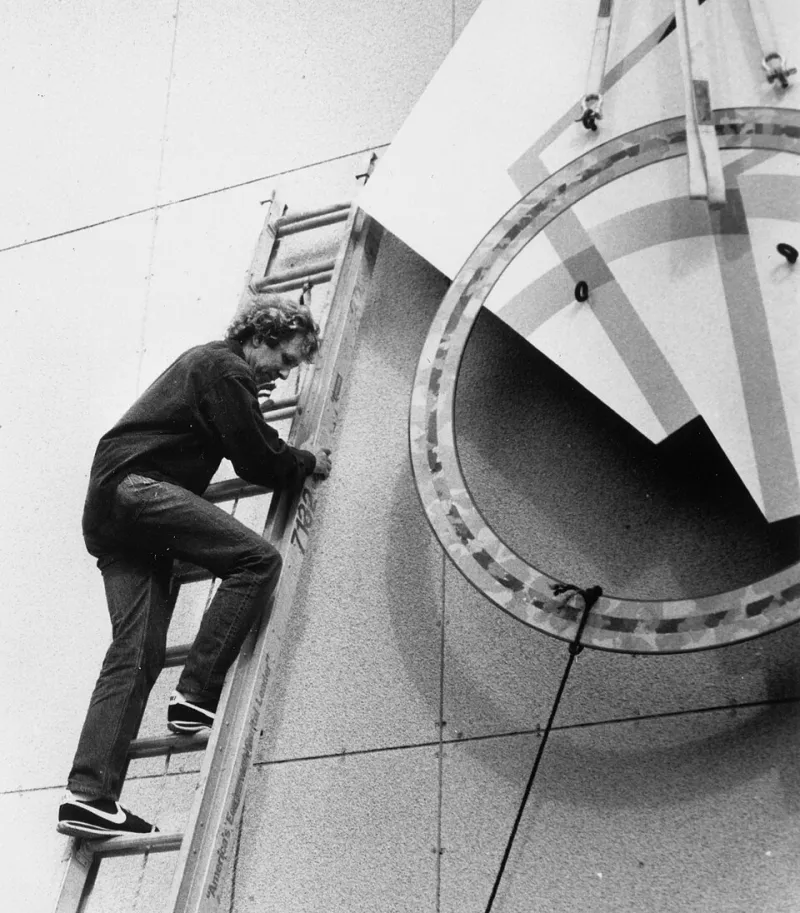
Photo: Imagemodern, CC BY-SA 4.0, via Wikimedia Commons
There's a particular kind of phone call that a certain type of artist has gotten very good at making. It goes something like this: they reach out to a city department, a property manager, a transit authority. They ask a question that's technically a request for permission but is worded so carefully, so precisely at the edge of what the institution even has a policy for, that the answer comes back as something like we'll look into it — which is to say, no answer at all. And then the work gets made.
This is not the same as asking forgiveness instead of permission. It's more subtle than that. It's asking permission in a way that makes permission structurally impossible to deny — or even to define. And it's become one of the more sophisticated creative strategies circulating through American art and activism right now.
The Bureaucratic Blank Space
Power structures, especially the institutional kind, are built to respond to clear violations. Security systems, legal codes, permit processes — they're designed to catch people who do something that's explicitly prohibited. What they're much worse at handling is work that exists in the spaces between rules.
Artists who've figured this out talk about it in almost tactical terms. A muralist in Chicago spent weeks combing through the city's public art ordinances before beginning a series of large-scale wheat-paste installations on retaining walls along the Metra corridor. Nothing she found explicitly prohibited temporary adhesive paper on those specific surfaces. She documented her research. She sent a letter to the city's Department of Cultural Affairs that described the project in formal language and invited a response. No response came. The work went up.
"I wasn't sneaking around," she's said in interviews. "I was being completely transparent about everything except the parts nobody had thought to make a rule about yet."
That gap — the part nobody has thought to make a rule about yet — is where a lot of the most interesting work is happening.
Underground Publishing and the Copyright Loophole Economy
The same logic shows up in underground publishing networks that have been quietly operating on the East Coast and in the Pacific Northwest for the better part of a decade. These aren't piracy rings in the traditional sense. They're more like extremely well-researched legal argument machines that happen to produce zines.
One network based loosely out of Portland has built an entire distribution model around texts that exist in genuinely ambiguous copyright territory — works whose rights holders are unknown, corporate entities that have dissolved, or materials created under government funding with unclear public domain status. They don't claim the work is free. They claim they cannot determine that it isn't, and they publish anyway, with meticulous documentation of every attempt they made to find out.
The documentation is the point. It doesn't just protect them legally (somewhat). It makes the ambiguity visible. It turns the uncertainty itself into part of the argument — about who owns culture, who gets to decide, and what happens to knowledge when the institutions responsible for it stop functioning.
The Calculated Ask
What distinguishes this approach from simple rule-breaking is the paper trail. Artists working in the gray zone tend to generate a lot of it. Emails sent and not replied to. Permit applications submitted for adjacent activities. Public records requests filed. Meetings attended.
A collective in Brooklyn that installs temporary sound sculptures in subway stations has gotten remarkably far on the strength of a single, extremely polite letter sent to the MTA four years ago. The letter described their project in terms that mapped onto several existing MTA arts programs without quite fitting any of them, and asked whether the collective should apply through Program A, Program B, or some other channel. The MTA never wrote back. The collective has treated that silence as provisional authorization ever since, citing the unanswered letter whenever anyone from transit authority approaches them.
"We're not pretending we have permission," one member explains. "We're demonstrating that we made every reasonable effort to get it and the institution failed to engage. That's a different legal and moral position than just doing whatever you want."
It is, in fact, a meaningfully different position. Legally, the distinction may or may not hold up in court depending on jurisdiction and specifics. But practically, it changes the entire dynamic of any potential confrontation. The burden shifts. The institution has to explain why it never responded, why it has no policy, why it couldn't be bothered to say no.
What This Reveals About How Power Actually Works
The gray zone strategy works precisely because most institutional power is lazy in a specific way. It relies on either clear compliance or clear violation. It's optimized for catching people who break obvious rules, not for engaging with people who expose the absence of rules.
This is something organizers have understood for a long time — the history of civil disobedience is full of moments where activists found that the law simply didn't say what authorities claimed it said. But artists working in ambiguous legality are doing something slightly different. They're not challenging laws directly. They're mapping the terrain where law hasn't arrived yet, and building there.
There's something genuinely experimental about it, in the O Project sense of the word. It's not just a legal tactic. It's a way of making visible the arbitrary nature of what gets permitted and what doesn't, of showing that the line between sanctioned and unsanctioned is often less about ethics or safety and more about who thought to write something down first.
The Risk Is Still Real
None of this is without consequence. The gray zone is not a safe zone. Artists have had work removed, faced fines, dealt with legal threats that — even when ultimately unfounded — cost time and money and energy nobody has to spare. The strategy is more protective than outright rule-breaking, but protection isn't immunity.
And there's a class dimension worth naming: the artists most able to operate in this space tend to be those with enough resources to document carefully, enough legal literacy to navigate permit language, enough social capital to get their letters taken seriously rather than immediately escalated. The gray zone, like most zones, is easier to inhabit if you've got certain advantages.
Still, the approach is spreading. Workshops on navigating public art permitting in ambiguous contexts are showing up in artist residencies. Zine distros are sharing templates for the kind of careful, unignorable correspondence that generates useful non-responses. The knowledge is moving.
And the work keeps getting made — in that productive, generative, impossible-to-quite-categorize space where nobody said yes, nobody said no, and something happened anyway.