Learned in the Kitchen: The Shadow Curriculum Passing Between Artists Right Now
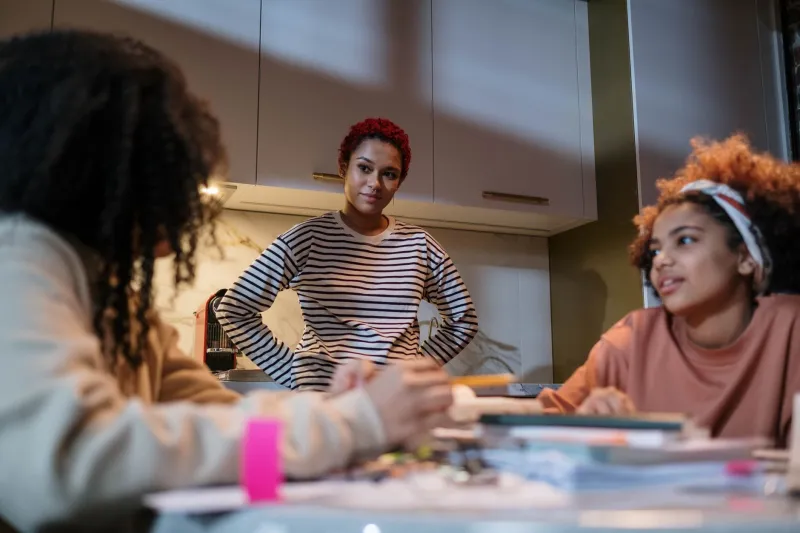
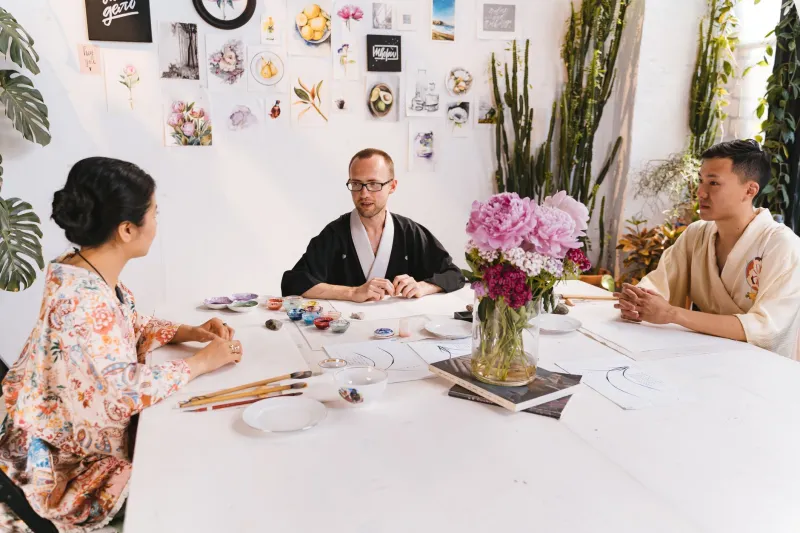
The class starts when everyone has a plate. Someone's explained how to use a riso printer. Someone else has walked three people through the basics of natural dye. By the time the dishes are done, two of the guests have traded phone numbers and made plans to meet next week so one can teach the other how to weld.
No syllabus. No certificate. No one is getting credit for any of this.
And yet — something real got transmitted.
What Universities Stopped Bothering to Teach
There's a version of art school that used to be about making things alongside people who knew more than you did. Watching. Asking questions. Getting corrected. Somewhere along the way, that version got buried under assessment rubrics, adjunct contracts, and the administrative machinery of accreditation. The studio time shrank. The mentorship got formalized into office hours. The weird, wandering conversations that used to happen in hallways got replaced by learning objectives.
Artists noticed.
What emerged — quietly, without anyone really naming it — was something that functions like a parallel education system. It's peer-to-peer, it's informal, and it moves through communities the way rumors do: person to person, context to context, with no central authority deciding what counts as knowledge worth passing on.
Call it the shadow curriculum. It's been operating for years. It's getting more intentional.
Skill Shares Are the New Studio Crit
In cities like Detroit, New Orleans, and Oakland — places where artists have had to build infrastructure because nobody was going to build it for them — skill shares have become a primary vehicle for this kind of learning. The format is loose by design. Someone volunteers to teach something specific: screen printing, basic bookkeeping for freelancers, how to apply for a grant without losing your soul, how to fix a sewing machine, how to have a hard conversation with a collaborator.
The room shows up. Questions get asked that would never appear on a midterm. The knowledge moves.
What makes these sessions different from a community college continuing ed class isn't just the lack of tuition. It's the directionality. In a skill share, the person teaching is usually still actively figuring things out. They're not presenting from a position of mastered expertise — they're sharing from inside a practice. That distinction changes everything about how the information lands.
People learn differently when the teacher is also a peer. They push back more. They contribute more. The session becomes a conversation instead of a lecture, and the learning goes in multiple directions at once.
Ephemeral by Design
One thing that stands out about these networks is how deliberately they resist documentation. Some of that is practical — nobody has time to write everything down. But some of it is philosophical.
There's a growing conviction in certain artist communities that the urge to archive and credential everything is itself a form of institutional capture. If you document a skill share, post it online, and build a curriculum around it, you've started the process of turning it into something that can be evaluated, ranked, and eventually gatekept. The knowledge stops moving freely and starts accumulating institutional gravity.
So some of these exchanges stay intentionally ephemeral. They happen once, in a specific room, for a specific group of people. The learning is real but the record is thin. What gets preserved is carried in the people who were there — which is, arguably, how knowledge has always worked best.
This isn't anti-documentation as a rigid ideology. It's more like a considered skepticism about what documentation is actually for, and who it serves.
The Network Nobody Mapped
What's striking, if you spend time in these communities, is how sophisticated the underlying network actually is. There are people who function as connectors — artists who seem to know everyone and have a talent for identifying when two people should meet because one has something the other needs to learn. There are recurring gatherings that serve as nodes, places where the network reconstitutes itself and new threads get added.
None of this appears on any org chart. There's no 501(c)(3) filing that describes it. But it's organized. It has logic and structure and, in its own way, pedagogy.
The pedagogy is just distributed. Instead of living in a single institution, it lives in relationships. The curriculum is assembled by each learner from whatever the network happens to offer them — which means it's radically personalized in a way that no accredited program can replicate.
Some artists describe this as learning by proximity. You put yourself near people who are doing interesting things and you absorb what you can. The trick is getting into the rooms where those people are, which is its own kind of barrier — but a different kind than tuition.
What Gets Taught That Couldn't Be Graded
Ask people what they've learned through these networks and the answers are specific in ways that resist easy categorization. How to negotiate without apologizing. How to read a contract for the clause that will hurt you later. How to know when a collaboration is over. How to make work when you have no money and no time and no one is paying attention.
This is the stuff that gets left out of formal curricula not because it's unimportant but because it's hard to standardize. It's contextual, relational, and deeply tied to the specific conditions of actually living as an artist in America right now — which means it has to be taught by people who are living that, not people who studied it.
The shadow curriculum doesn't pretend otherwise. It teaches what it knows, from where it stands, to whoever shows up.
Why This Matters Beyond Art
It would be easy to frame this as a niche concern — artists doing what artists do, building weird little systems on the margins. But the questions these networks are working through are not marginal at all.
Who decides what knowledge is worth transmitting? Who gets to teach? Who gets access to learning? What gets lost when education becomes a credentialing transaction rather than a human exchange?
Artist communities have been asking these questions by necessity, because the formal systems weren't working for them. The answers they're arriving at — through potlucks and skill shares and late-night conversations and ephemeral workshops in borrowed spaces — might be useful to a lot more people than just artists.
The kitchen is open. Bring something to share.