Block by Block: The Neighborhoods Rewriting the Rules of How Cities Work
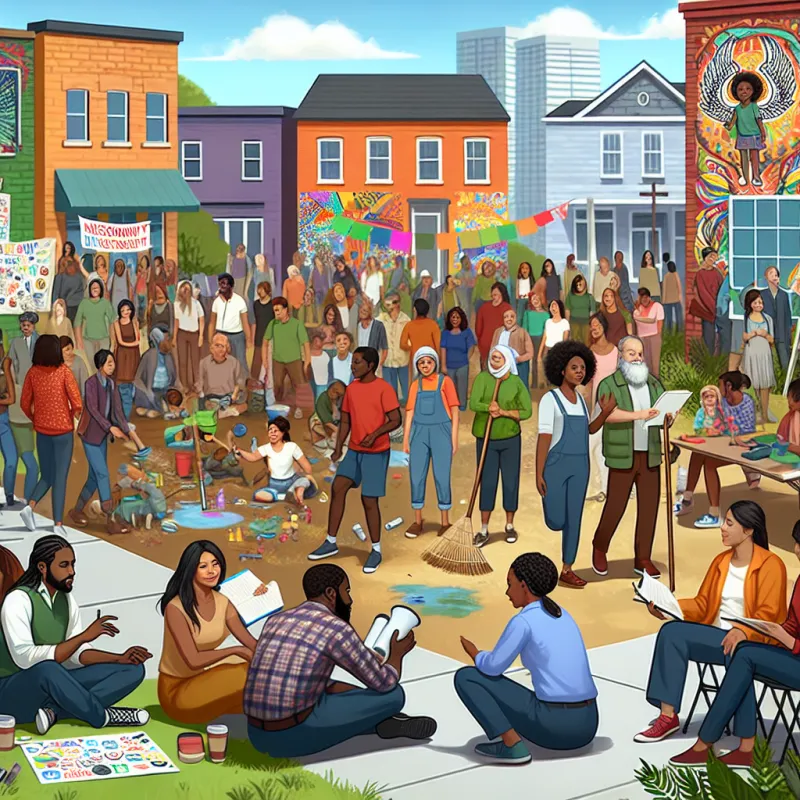
Photo: community meeting neighbors urban neighborhood organizing grassroots, via homesight.org
The city council meeting starts at 7pm. There are three people in the public comment section. The agenda has seventeen items. By the time residents get to speak, it's 9:45 and half the council members are checking their phones.
Anybody who's sat through one of these meetings knows the feeling: the gap between what official democracy looks like and what actual democratic participation could feel like. That gap is enormous. And in neighborhoods across the country, people are quietly deciding not to wait for it to close.
The Pop-Up Governance Moment
Something has been building in American cities for the better part of a decade — a loose, decentralized wave of what you might call DIY democracy. It doesn't have a single name or a unified theory. But it has a recognizable shape: small groups of residents, usually in neighborhoods that have been underserved or actively harmed by official city systems, building their own structures for making collective decisions.
In Minneapolis, a network of block clubs in the Near North neighborhood has been running what they call "infrastructure assemblies" — monthly gatherings where residents vote on how to allocate a shared fund for hyperlocal improvements. We're talking about things like community composting stations, free libraries, shared tool sheds. Small stuff. But the process is the point: real decisions, made by actual neighbors, without a city bureaucracy in the middle.
In Jackson, Mississippi, the legacy of Cooperation Jackson — the community organizing and economic development project rooted in the city's Black working-class neighborhoods — continues to influence how residents think about land, labor, and local governance. The model there has always been about building dual power: creating functional community institutions that can operate independently of, and sometimes in opposition to, official structures.
When Infrastructure Becomes Political
One of the most interesting things happening in these hyperlocal experiments is the blurring of lines between infrastructure and politics. When a collective in East Oakland builds a community fridge network and coordinates its maintenance through a shared digital platform with rotating stewardship responsibilities, that's not just mutual aid. That's a governance structure. It has rules, accountability mechanisms, and a theory of who gets to make decisions.
Same goes for the groups in Philadelphia and Detroit that have been turning vacant lots into community-managed green spaces — not through the official city land bank process, which can take years, but through direct relationships with landowners, legal support from community land trust organizations, and sheer organizational persistence.
These projects don't always use the language of governance or democracy. Often they're described in more practical terms: "we needed a park, so we made one." But the underlying logic is genuinely radical. It says: we don't need permission to build the neighborhood we want to live in.
Participatory Everything
Participatory budgeting — the process of giving residents direct control over a portion of public funds — has been around long enough now that it's almost mainstream in some cities. New York City ran one of the largest programs in the country for years. But the interesting edge of this work is happening at scales smaller than city government.
Some neighborhood associations and community development organizations have started running their own participatory budgeting processes completely independently, using pooled community funds, foundation grants, or even crowdsourced dollars. The city isn't involved. The decisions are made by whoever shows up — with real effort put into making sure "whoever shows up" isn't just the same ten people who always show up.
In Portland, Oregon, a collective called the Eastside Commons has been experimenting with what they call "rotating facilitation" — a system where meeting leadership cycles through all participating households on a regular basis, with training provided for anyone who wants it. The explicit goal is to break up the informal hierarchies that tend to calcify in any group, however well-intentioned.
"Every group has power dynamics," one of the founding members explained. "The question is whether you're going to name them and work with them, or pretend they don't exist and let them run the show from the background."
The Tension With Scale
Here's the honest complication in all of this: hyperlocal democracy is really good at some things and genuinely limited at others. A block club can decide where to put a community garden. It can't negotiate a new bus route or address a regional housing affordability crisis.
The most thoughtful organizers in this space are acutely aware of this tension. They're not arguing that neighborhood-level governance should replace city or regional systems. They're arguing that it should exist alongside them — and that the practice of making real decisions together at the small scale builds the civic muscles needed to engage more effectively at larger scales.
There's also the question of who participates. Hyperlocal organizing, for all its grassroots appeal, can reproduce the same exclusions as formal politics if it's not actively working against them. Language access, meeting times, childcare, the simple fact of who feels welcome in a room — these aren't afterthoughts. They're the whole game.
Democracy as a Practice, Not a Product
What ties these experiments together isn't a shared ideology or even a shared set of tactics. It's a shared intuition: that democracy is something you do, not something you receive. That waiting for official systems to become more responsive is a strategy that hasn't been working, and that building something functional in the meantime isn't defeatism — it's pragmatism with a political edge.
The neighborhoods doing this work aren't trying to secede from the city. They're trying to build enough collective capacity, trust, and institutional knowledge that when they do engage with official systems, they're doing it from a position of strength rather than supplication.
Block by block, that's a different kind of city. It doesn't show up in any single election or policy win. It shows up in the fact that a group of neighbors who've been making decisions together about a community garden are also the people who show up organized when the city tries to rezone their neighborhood. Practice makes power.
And somewhere in that equation — in the messy, imperfect, wildly human work of figuring out how to share a block — is something that looks a lot like democracy actually working.